
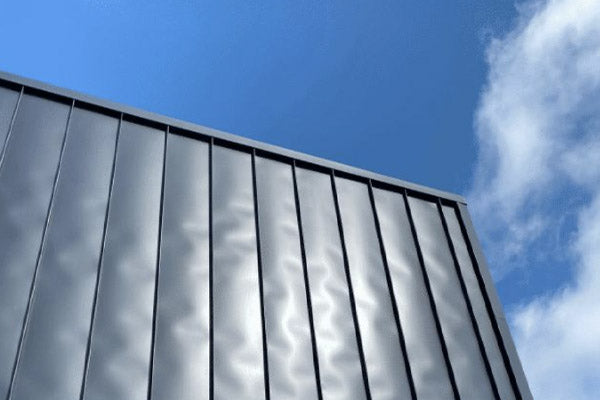
If you’ve ever noticed a faint waviness across the flat face of a steel garage door, roof or wall panel, you’ve seen oil canning. It’s one of the most common questions we’re asked about wide, flat steel — and the short answer is reassuring: it’s an appearance characteristic of the material, not a fault in your door. Here’s what causes it, why it happens, and the practical steps that keep it to a minimum.
Quick answer
Is oil canning a defect? No. Oil canning is a visual effect only. It doesn’t change the strength, weather performance or lifespan of a steel door or panel. Unless specific flatness tolerances have been agreed in writing before you order, it isn’t grounds for rejecting a panel.
What oil canning actually is
Oil canning is the slight waviness or “ripple” that can appear in wide, flat areas of rolled steel. It shows up more readily in thinner gauges and across broader flat pans — exactly the kind of surface you find on many sectional garage door panels and steel cladding.
Because it’s really a light-and-reflection effect, the same panel can look perfectly flat in the morning and show a faint wave by mid-afternoon as the light and temperature shift through the day. It tends to be most noticeable on large surfaces, steep slopes, or anything viewed at an angle.
What causes it
Oil canning rarely comes down to a single cause. It’s the sum of several factors, many of which sit outside any one manufacturer’s control:
- Residual stresses locked into the steel during coil production and roll-forming
- The panel’s width, gauge, colour and surface finish
- How the sheets are handled and stored before they go up
- How flat, square and true the supporting structure is
- Installation technique and the way fixings are set
- Normal thermal expansion and contraction once the door is in service
Because so many variables combine, oil canning can never be entirely eliminated. But thoughtful product choice and careful installation reduce it substantially.
How good installers keep it to a minimum
Correct handling and installation do most of the heavy lifting. Panels should be carried by two people, hanging vertically and free of twist, so no stress is introduced before fixing. On install, each panel is allowed to settle into a relaxed, natural position before it’s fastened — never pulled, forced or held under tension, which is a classic way to bake a wave into the surface.
What this means when you’re choosing a steel garage door
A few decisions at the ordering stage stack the odds in your favour:
- Favour narrower profiles and thicker gauges where the design allows — both resist waviness
- Lean toward lighter colours and matt finishes; a matt COLORBOND® tone hides far more than a dark, glossy one
- Make sure the opening and supporting structure is flat, square and in one plane — no dips or humps for the panel to telegraph
- Take extra care around openings, corners and cut edges, where stresses concentrate
The essentials
- Oil canning is a normal characteristic of wide, flat steel — aesthetic only, never structural.
- It’s driven by a mix of steel stresses, profile, handling, structure, fixing and temperature.
- Narrower profiles, thicker gauges and lighter matt colours all reduce how visible it is.
- Careful, experienced installation is the single biggest lever.
- For appearance-critical jobs, talk through profile, colour and fixing before you order.
The technical guidance in this article draws on Stramit’s Technical Insider (Issue 3, June 2026). For full engineering detail, refer to Stramit’s SharpLine technical manual or BlueScope’s website.
Not sure which profile or finish suits your opening?
Talk to the Doorsupply team before you order. We’ll help you match the door, colour and finish to your site — so you get a result you’re happy to look at every day.