
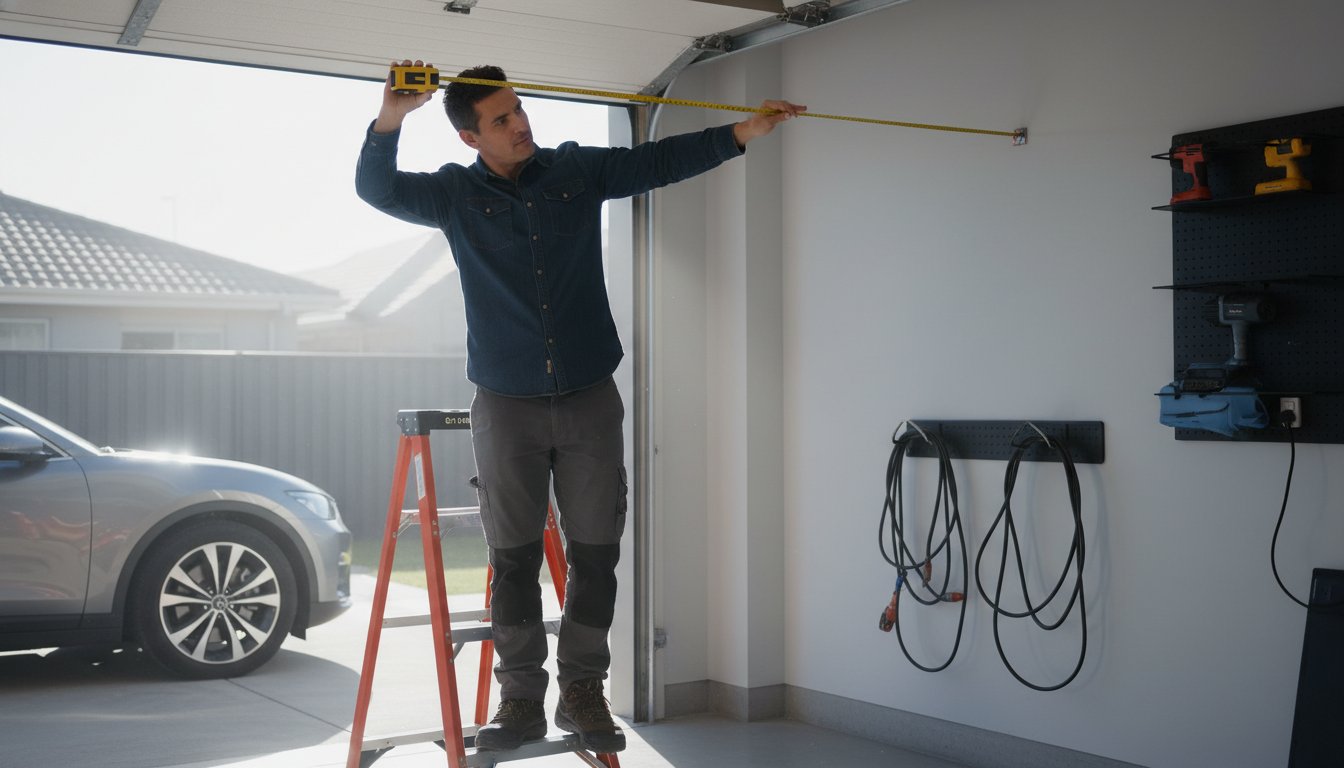
Ordering a made-to-order garage door requires precise measurements. An error of just a few millimetres can result in a door that doesn't fit, wasting time and significant money. The key to a successful DIY garage door measuring project is getting the initial numbers right. Learning how to measure a garage door eliminates risk and confusion. Additionally, understanding how to size a garage door opener ensures your automatic motor works efficiently without strain.
This guide provides the exact process you need to accurately measure for a garage door, eliminating the risk and confusion. Whether you're considering a roller door or a sectional door, the principles of correct measurement are critical for a successful installation.
Forget the guesswork and the fear of a costly mistake. This garage door measurement guide covers everything you need: a clear, step-by-step checklist for all required dimensions: opening height and width, headroom, sideroom, and backroom. We explain how to account for uneven floors and work around common obstructions like pipes or support beams. Use this ultimate DIY guide to gather the correct specifications, understand the requirements for your chosen door type, and order your custom garage door sizing with complete confidence.
Preparation: Tools and Key Garage Door Terminology
To ensure your new, made-to-order roller door fits perfectly, accurate measurements are non-negotiable. This is the most critical step when you measure for garage door installation yourself. Precision prevents costly mistakes and ensures a smooth, secure operation. Before you begin, gather the right equipment and familiarise yourself with the key terms.
For a practical overview, this video provides a clear visual guide to the process:
One critical rule to remember: all measurements must be taken from inside your garage, looking out. This perspective is essential for determining the correct fitment for the door's curtain, tracks, and motor. You will be taking five key measurements to ensure a perfect fit, which we will detail in the next section.
Essential Tools You'll Need
Having the correct tools on hand makes the job faster and more accurate. You don't need a complete workshop, just a few key items:
- A quality tape measure: Ensure it is at least 8 metres long to handle standard double garage openings without issue.
- A spirit level or laser level: Crucial for checking if your floor and lintel are level and your jambs are plumb (vertically straight).
- A sturdy step ladder: For safely and accurately reaching the top of the garage opening and measuring headroom.
- A notepad and pen, or a smartphone: To record your measurements clearly. Taking photos of the opening and surrounding area is also recommended.
Understanding the Lingo: A Simple Glossary
Getting the terms right is the first step. While there is a lot of specific garage door terminology, these are the five key measurements you need for ordering a roller door. All terms are from the perspective of being inside the garage.
- Opening Width & Height: This is the clear, finished opening of your garage that the door will cover. Measure the width at the top, middle, and bottom, and the height on the left, middle, and right. Use the largest measurement for each.
- Sideroom (or Jamb): The clear wall space on the left and right sides of the garage opening. A roller door requires a minimum amount of sideroom for the guide tracks to be mounted.
- Headroom (or Lintel): The clear, unobstructed space from the top of the opening up to the ceiling or the lowest obstruction (like rafters or pipes).
- Backroom: The clear depth available from the garage door opening back into the garage. This measurement ensures the rolled-up door curtain and any motor will not hit anything when installed.
4 Key Steps: How to Measure a Garage Door Opening
Step 1: Measuring The Core Garage Opening
Before selecting a door, you must determine the precise dimensions of your garage opening. These initial figures-width and height-are the foundation for everything that follows. They are essential regardless of whether you plan to install a roller, sectional, or custom door. To get a correct measure for garage door installation, accuracy is non-negotiable. Garages are rarely perfectly square, so we follow a simple rule: measure three times and use the smallest dimension. This ensures the door we supply will fit without binding or leaving unsightly gaps.
Have a tape measure, spirit level, and a pen and paper ready. Record these numbers clearly before moving to the next step.
How to Measure the Opening Width
To account for any variations in the side jambs, you will take three separate horizontal measurements of the finished opening.
- Top: Measure the distance across the top of the opening, from jamb to jamb.
- Middle: Measure across the middle point of the opening.
- Bottom: Measure the distance across the bottom of the opening.
Compare your three figures and record the smallest of the three measurements. This is your final opening width.
How to Measure the Opening Height
Similarly, an uneven concrete floor can affect the door's seal. Taking three vertical measurements ensures the door will close properly without gaps.
- Left Side: Measure the height from the floor to the top of the opening (head) on the left side.
- Centre: Measure the height in the centre of the opening.
- Right Side: Measure the height on the right side.
Once again, identify and record the smallest of the three measurements. This is your final opening height.
Checking if Your Opening is Plumb and Level
A final check confirms the structural integrity of your opening. Use a spirit level to verify two things:
- Plumb Jambs: Place your level vertically against the inside face of the left and right side jambs. The bubble should be perfectly centred, indicating the sides are plumb (perfectly vertical).
- Level Floor: Place the level on the floor across the opening. Check that the floor is level where the door will sit.
Note any significant deviations. While minor imperfections are common, a substantially out-of-plumb or unlevel opening may require attention from a builder before a new door can be installed correctly.
Step 2: Measuring Space for a ROLLER DOOR
Unlike other garage door types, roller doors have specific spatial requirements for the door curtain roll and the mounting of its tracks. The most common and costly mistakes occur when measuring headroom and sideroom. These clearance measurements are not optional; they determine if a roller door can be physically installed in your garage. Getting this step right is a critical part of how you measure for a garage door, ensuring the product you order will actually fit.
Before taking any other measurements, you must confirm your garage has the necessary space. This is an essential preliminary check in the guide on how to measure for a garage door. Failure to meet these minimum dimensions means a standard roller door installation is not possible.
Measuring Headroom for the Door Roll
Headroom is the clear, unobstructed vertical space directly above the garage door opening. To measure it, run your tape measure from the top of the opening (the underside of the lintel) straight up to the ceiling or the first obstruction you hit, such as a beam, pipe, or ducting. This is a simple but crucial way to measure for a garage door's roll clearance.
- Standard Requirement: A minimum of 450mm of clear headroom is required for most standard domestic roller doors.
This space is essential to accommodate the door curtain as it rolls up into a bundle when opened. Without adequate headroom, the door roll will hit the ceiling or obstruction, preventing the door from opening fully.
Measuring Sideroom for Tracks and Motor
Sideroom refers to the clear wall space on the left and right-hand sides of the garage opening, viewed from inside the garage. This space is needed to mount the vertical tracks and the motor. Measure from the edge of the opening sideways to the nearest wall or obstruction.
The minimum requirements are different for the motor side versus the non-motor side:
- Non-Motor Side: You need at least 100mm of clear wall space for the support bracket and track.
- Motor Side: You need at least 250mm of clear wall space to accommodate the track, support bracket, and the drive motor assembly.
Correctly checking these clearance dimensions is a non-negotiable step when you measure for a garage door. If you do not have this required space, the components cannot be installed securely or function correctly.
Step 3: Measuring Space for a SECTIONAL DOOR
Unlike a roller door that rolls into a bundle, a sectional door is made of hinged panels that retract along horizontal tracks parallel to your garage ceiling. This design means that when you measure for a garage door of this type, the most critical dimensions are headroom (the space above the opening) and backroom (the clear depth into your garage).
Getting these measurements correct is essential for the door to operate smoothly and fit correctly. Incorrect measurements can prevent the door from opening fully or require costly structural modifications.
Measuring Headroom for Horizontal Tracks
Headroom is the clear, unobstructed space from the top of the garage door opening to the ceiling or the lowest obstruction (like pipes or rafters). This space is required to accommodate the curve of the track and the spring system.
- Standard Headroom Requirement: A minimum of 350mm is needed for a standard installation with a torsion spring system.
- Low Headroom Kits: If you have less than 350mm, low headroom kits are available. These typically require a minimum of 220mm and use a different track and spring configuration.
Measuring Sideroom for Vertical Tracks
Sideroom is the clear wall space on either side of the garage door opening. This area is necessary for mounting the vertical tracks, cables, and tensioning system that guide the door as it moves up and down.
- Minimum Sideroom Requirement: You need at least 120mm of clear space on each side of the opening. Ensure this area is free from any obstructions like wall switches, plumbing, or shelving.
Measuring Backroom for the Open Door
Backroom (or rear clearance) is the clear distance from the garage door opening back towards the rear wall of the garage. This measurement is crucial to ensure the door can retract fully into the open position without hitting anything.
The required backroom is calculated based on the height of the door itself, plus additional space for the automatic opener (motor) and its components. As a general rule, you will need:
Required Backroom = Door Height + 500mm to 1300mm (for the motor)
Always measure to the nearest permanent obstruction. Once you have these precise figures, you can confidently select a product. You can view the specific technical requirements for our range on our sectional doors page.
How to Size a Garage Door Opener Correctly
Once you know how to measure a garage door, sizing the opener is the next step:
-
Single Doors (up to 10m²): Require a standard 600N - 800N motor.
-
Double / Heavy Steel Doors: Require 1000N - 1200N heavy-duty openers.
-
Side Room Clearance: Roller door openers require 85mm–135mm side axle clearance.
Step 4: Final Checks and Avoiding Common Mistakes
Before you place your order, this final review will prevent costly mistakes. Taking a few extra minutes now separates a smooth DIY project from a frustrating one. Double-check every measurement on your diagram against the notes you took. We also recommend taking clear photos of the inside of your garage opening, paying close attention to any potential issues you identified.
This final check is the most important part of the process when you measure for garage door installation, ensuring the product you receive is exactly what you need.
Identify All Obstructions
A new roller door requires clear, unobstructed space to operate safely and correctly. Walk inside your garage and carefully inspect the sideroom, headroom, and backroom areas where the door and its tracks will be installed. Look for:
- Pipes, electrical conduit, or HVAC ducting.
- Overhead light fixtures or storage shelving.
- Internal access doors that could be blocked by the new door's vertical tracks.
- Power Point: If ordering an automatic opener, confirm a standard power point is located within reach of the planned motor position.
Confirm Vehicle and Driveway Clearance
The door opening height is not the only factor for vehicle access. A common oversight is forgetting to account for vehicle size and the approach to the garage. Check the following:
- Vehicle Height: Measure your tallest vehicle, especially if it's a 4WD or van with roof racks or other accessories.
- Driveway Slope: If your driveway slopes upwards towards the garage opening, your effective entry clearance will be lower than the opening height.
- Ensure the final "drive-through" clearance, with the door fully open, is sufficient for your vehicle to pass through without contact.
Converting Your Measurements for Ordering
The size you order is the door (curtain) size — not your opening size. In Australia, roller doors are always sold larger than the opening so the curtain overlaps into the guides on each side. For standard Taurean Series A doors (up to 3430mm wide), add 50mm to your opening width (25mm each side). For wider Series AA doors, add 100mm (50mm each side). Height is ordered to match your lintel height — the roll is accounted for by the factory. So if your brick-to-brick opening is 2400mm wide, you order a 2450mm door. It's a simple addition, not complex maths.
Ready to order? View our range of Australian-made garage doors.
Your Measurements: The Key to the Perfect Garage Door
You now have the exact specifications needed to confidently measure for a garage door. This guide has equipped you with the correct process, from checking your opening dimensions to confirming the crucial headroom and sideroom required for a flawless fit. Understanding the different requirements for roller and sectional doors is the final piece of the puzzle, ensuring you avoid costly mistakes.
With your measurements complete, the next step is simple. Door Supply is a Supply Only service, perfect for the DIY expert. Find your ideal fit from our range of Proudly Australian Made & Manufactured doors, and get it delivered with our Nationwide Delivery to Your Door service.
Use your measurements to find the perfect door now.
You've done the hard work. Now you’re ready to order with confidence and get the job done right.
Frequently Asked Questions
What are the standard garage door sizes in Australia?
While there are common sizes for new builds, such as 2400mm wide for a single opening and 4800mm for a double, there is no single "standard" size. Most garage openings have slight variations. That is why all our doors are made to order based on your specific measurements. This ensures a perfect fit for your home, whether it’s a standard single, double, or a custom-sized opening. Providing accurate dimensions is the key to a successful installation.
My measurements are slightly different at the top and bottom. Which one should I use?
If your opening is not perfectly square, always use the smallest measurement. For the width, measure at the top, middle, and bottom, and use the narrowest figure. For the height, measure on the left and right sides and use the shortest figure. This ensures the garage door will fit within the tightest points of the opening and operate smoothly without catching on the frame. It is critical for an accurate and functional installation.
How much headroom do I need for a garage door?
Headroom is the clear space from the top of the opening to the ceiling. A standard domestic roller door requires approximately 450mm of headroom to accommodate the door roll. A sectional door typically needs less, around 350mm. You will also need adequate sideroom-the space on either side of the opening-which is usually a minimum of 150mm for the tracks and brackets. Always check the specific product requirements before ordering.
What if I don't have enough headroom for a standard roller or sectional door?
If you have limited headroom, there are still options available. For sectional doors, low-headroom kits with rear-mounted torsion systems can reduce the space requirement significantly. For roller doors, in some cases, a smaller door model with a tighter roll diameter may be suitable for your opening. It is important to measure your available headroom accurately to determine the best solution for your garage. Contact us with your measurements for specific advice.
Can I measure for the door myself even if I plan to hire someone for installation?
Yes, absolutely. Our detailed guides are designed to help homeowners accurately measure for a garage door. As we are a supply-only service, providing us with the correct measurements is the customer’s responsibility. Taking these measurements yourself ensures the door is manufactured to the exact specifications required for your opening, which is essential information for you or your chosen installer. This process saves time and prevents costly errors during the installation phase.
What's the difference between a reveal fit and a face fix installation?
A face fix (or face mount) is the most common installation method. The door is mounted to the internal wall of your garage, overlapping the opening. A reveal fit means the door is installed directly within the garage opening, sitting between the jambs and below the lintel. A reveal fit will reduce the drive-through width and height of the opening, so it is crucial to account for this when measuring and deciding on an installation type.
Do I need to account for an automatic opener when I measure?
You do not need to adjust the door measurements for an automatic opener. The door is ordered to fit the opening. However, you must ensure you have sufficient headroom and sideroom to accommodate both the door and the opener motor and its components. The standard headroom requirements for our doors are typically sufficient for most modern openers, but it is always best to check the specifications of the opener you plan to install.