
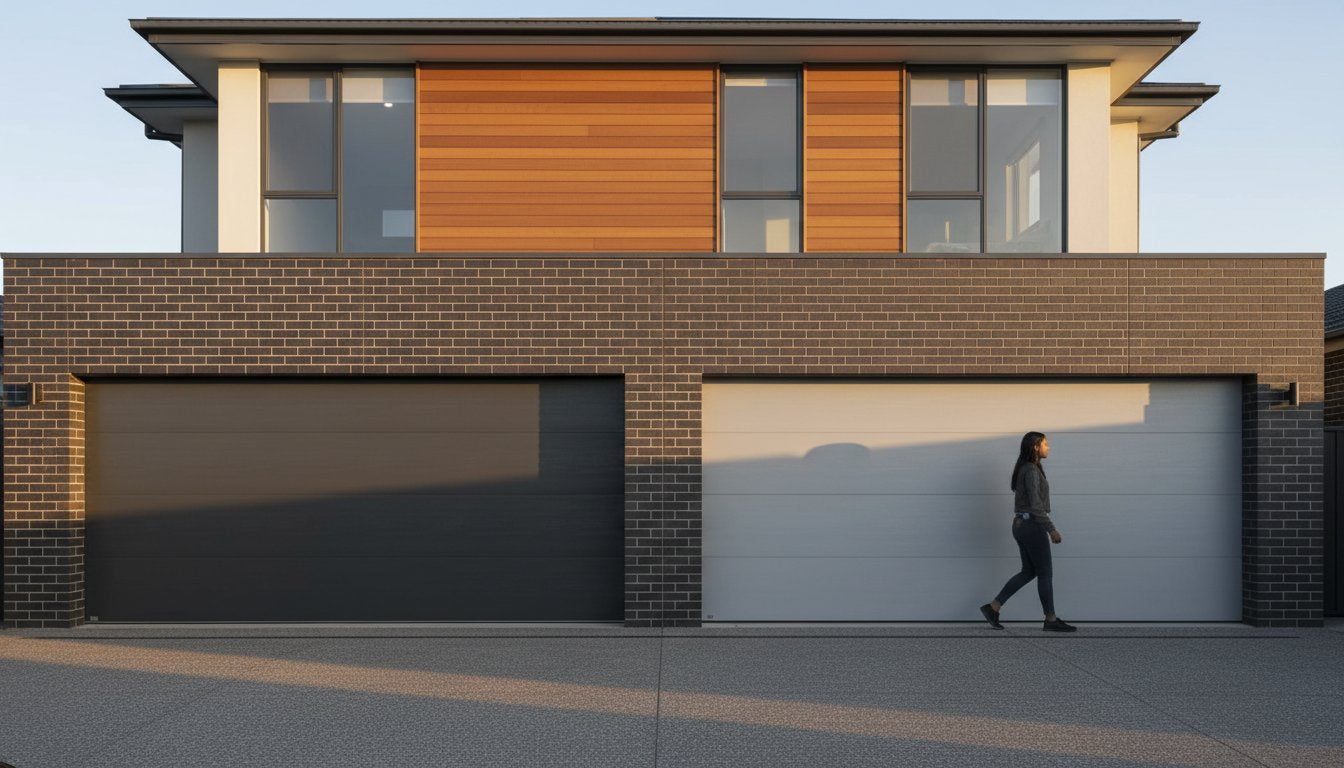
Choosing a new garage door comes down to facts. Will it fit with your limited headroom? What is the real cost difference? How difficult is the DIY installation? These are the critical questions when deciding in the roller door vs sectional door debate. Making the wrong choice for your property is a costly mistake in both time and money, and a hassle you don't need.
This guide delivers a direct, no-nonsense comparison. We cut straight to the essential details, breaking down the specific differences in headroom and space requirements, available design options, overall cost, and installation complexity for a supply-only project. The goal is simple: to provide the clear, practical information you need to confidently select the right Australian-made, made-to-order door for your home. You'll leave with a clear understanding and the confidence to make the right purchase.
At a Glance: Roller Door vs Sectional Door Quick Comparison
Choosing between a roller door and a sectional door is the first major decision for any garage build or replacement. The primary difference lies in their operation and the space they require inside your garage. This guide breaks down the essential factors to help you select the right 'supply only' door for your needs.
For a clear visual of how each door operates, watch this short video:
Here is a direct comparison of the most important features to consider.
| Feature | Roller Door | Sectional Door |
|---|---|---|
| Mechanism | A single curtain of steel rolls up into a cylinder above the opening. | Hinged panels slide up and back along tracks, sitting parallel to the ceiling. |
| Required Headroom | Requires significant headroom for the roll (approx. 400-500mm). | Requires less headroom, as panels sit flat (approx. 200-350mm). |
| Cost (Upfront) | Generally more affordable for the initial purchase price. | Higher initial cost due to complex mechanism and panel design. |
| Aesthetics | Functional, industrial look with limited profiles (e.g., standard ribs). | Wide range of designs, windows, finishes, and colours. |
| Security | Very secure due to the continuous, solid curtain design. | Highly secure with robust panel construction and locking systems. |
| DIY-Friendliness | Simpler installation for those with good DIY skills. | More complex installation requiring precise track and spring assembly. |
How They Operate: Rolling vs. Sliding
The mechanics are straightforward. A roller door consists of a continuous curtain of ribbed steel that rolls up into a compact cylinder above the opening. In contrast, a sectional door is made from several large, rigid panels hinged together. These panels run on vertical and then horizontal tracks, sliding up and back to sit parallel with the ceiling when open. While these are the two most common options in Australia, you can learn more about all Types of Garage Doors to understand the fundamental engineering.
The Core Decision Factors
When making your roller door vs sectional door decision, three factors usually override all others. Your choice will almost always come down to a balance of these practical considerations:
- Space: Headroom-the clear space above your door opening-is the most critical measurement. Roller doors need more vertical space for the roll, while sectional doors need clear ceiling space for the tracks to run along.
- Budget: For a standard single or double garage, roller doors are typically the more cost-effective option for the initial purchase. Expect to pay more upfront for the design flexibility and panel construction of a sectional door.
- Style: Sectional doors offer superior customisation. You can choose from various panel designs (e.g., slimline, flat, heritage), colours, and even add windows. Roller doors offer a more functional look with fewer design options.
Space Requirements: The Most Critical Measurement for Your Garage
Before comparing colours or motor options, the first and most important step is to measure your garage opening. For a DIY or supply-only purchase, this is the most critical factor. An incorrect measurement is a costly mistake, as all our doors are made to order and cannot be returned. Getting the space requirements right determines which door type is even possible for your property.
The key measurements you need are headroom (or sideroom for some installations), the structural opening height, and the opening width. For precise instructions on how to get these numbers correct, please refer to our detailed ‘How to Measure’ guide before placing an order.
Headroom Explained: Why It Dictates Your Choice
Headroom is the clear, unobstructed space between the top of your garage door opening and the ceiling (or the lowest-hanging obstruction, like a beam or pipe). This single measurement is often the deciding factor in the roller door vs sectional door debate, as each has very different needs.
- Roller Doors: Require significant headroom to house the rolled-up door curtain. A standard domestic roller door typically needs at least 450mm of clear space above the opening.
- Sectional Doors: Need less direct headroom, usually around 350mm, for the door’s top panel to curve onto the horizontal tracks. However, they require clear ceiling space running back into the garage.
Driveway and Internal Space Considerations
Because both roller and sectional doors open vertically, they are excellent for properties with short driveways, allowing you to park a vehicle right up to the door. The main difference is how they use the internal space inside your garage.
A sectional door retracts along horizontal tracks suspended from the ceiling. This can limit your overhead storage options for long items like ladders or surfboards and may obstruct the installation of a car hoist or prevent parking a tall 4x4 with roof racks. You must also check for any obstructions along the ceiling and walls where tracks will be mounted, including beams, plumbing, or internal access doors. Ensuring clear space is not just for a clean fit; it's critical for the safe function of the automatic motor. Faulty installation can interfere with safety mechanisms, which are governed by strict regulations. You can review the principles behind these in the Official Safety Standards to understand why precision is vital.
Design & Aesthetics: Matching the Door to Your Home's Style
A garage door is a significant part of your home's facade and has a major impact on its curb appeal. When comparing a roller door vs sectional door, the primary difference comes down to visual style and customisation. While both are made from durable steel and available in a wide range of Colorbond colours to match your property, they serve different aesthetic purposes.
Roller Door Styles: Classic and Functional
The roller door is defined by its classic, corrugated steel curtain. This ribbed profile provides strength and durability, making it an excellent, no-nonsense choice. Its design is best suited for sheds, industrial-look homes, or any garage where practicality and function are the main priorities. Beyond the extensive Colorbond colour chart, customisation options are limited, reinforcing its role as a tough and reliable workhorse.
Sectional Door Styles: Modern and Versatile
For homeowners seeking design flexibility, the sectional door is the premium choice. It is constructed from a series of wider, interlocking panels that offer a flat, modern appearance. The design options are extensive:
- Panel Profiles: Choose from various designs, including Slimline, Heritage, and Flat profiles to complement your home's architecture.
- Windows: Add acrylic or perspex window inserts to allow natural light into your garage.
- Premium Finishes: Opt for a high-end timber look with finishes like DecoWood for the warmth of wood without the maintenance.
These advanced customisations allow for a truly integrated look but are a key factor in the final Garage Door Installation Cost. The aesthetic versatility makes the sectional door a clear winner for modern homes where the garage is a key architectural feature.
Insulation Options
Insulation is another key point of difference in the roller door vs sectional door debate. Insulated panels are almost exclusively an option for sectional doors. The benefits are purely practical: improved temperature control inside your garage and a noticeable reduction in noise transfer from the street. Standard single-skin roller doors are not typically insulated, which aligns with their focus on simplicity and core function.
Cost, Security, and Maintenance: A Long-Term View
The sticker price is only the beginning of your investment. To make a smart choice in the roller door vs sectional door debate, you need to consider the total cost of ownership. This includes the upfront purchase price, long-term security, durability, and the ease of maintenance and potential repairs.
Upfront Purchase Price
Your initial outlay will be one of the biggest deciding factors. As a general rule for a standard residential garage opening:
- Roller Doors: Are typically the more budget-friendly option. Their simpler construction and manufacturing process result in a lower purchase price.
- Sectional Doors: Have a higher initial cost. This is due to their complex panelled construction, additional hardware like hinges and rollers, and more involved tracking system.
The final price for either door is influenced by factors such as the door size, your choice of automatic motor, custom Colorbond® colours, and whether you require a wind-rated door for high-wind or cyclonic regions.
Security and Durability
While both door types provide a strong physical barrier, there are differences in their construction. Sectional doors are often considered more robust due to their thick, insulated panels and rigid structure, which makes them highly resistant to forced entry. However, a modern roller door is far from insecure. When fitted with wind-locks, the curtain is securely anchored into the guide tracks, significantly boosting its strength. Ultimately, the greatest security feature for both doors is a high-quality automatic opener with modern encryption and a reliable locking mechanism.
DIY Maintenance and Repairs
Thinking about long-term upkeep is crucial. A key difference when comparing a roller door vs sectional door is how they handle wear and accidental damage.
For routine maintenance, a roller door is simpler, with fewer moving parts to check. Keeping the tracks clean is the main task. A sectional door has more components-hinges, rollers, and multiple track sections-that require regular inspection.
In the event of damage, such as a vehicle impact, repair costs can vary significantly. A damaged sectional door may only require one or two panels to be replaced, which can be a cost-effective fix. A significant dent or tear in a roller door curtain often means the entire curtain must be replaced.
Ultimately, the right door offers the best value for your specific needs, balancing budget with performance. To compare pricing on Australian-made doors, you can view our full range online.
The Final Verdict: Which Garage Door Should You Choose?
Choosing between a roller door and a sectional door doesn't have to be complicated. The best choice is the one that fits your space, budget, and design preferences. To make your decision easier, we've created a simple checklist. See which category best describes your needs.
Choose a Roller Door If...
A roller door is the practical, efficient choice for many Australian homes and sheds. It's likely the right fit for you if:
- You have plenty of headroom above the door opening (at least 450mm is ideal for the door to roll up).
- Your main priorities are functionality, durability, and a cost-effective price point.
- You need a simple, reliable door for a high-use garage, shed, or carport.
- You prefer a classic, corrugated look that is simple and unobtrusive.
Choose a Sectional Door If...
A sectional door offers premium features and a modern aesthetic. This is the superior option when:
- You have limited headroom but clear, unobstructed ceiling space for the door panels to retract into.
- Curb appeal is a top priority and you want a sleek, modern finish for your home's facade.
- You want the flexibility to add features like windows for natural light, insulation for thermal efficiency, or premium timber-look finishes.
- You require the most robust and secure garage door option available on the market.
Ready to Buy? Here's How
Now that you've settled the roller door vs sectional door question for your property, the next step is simple. Remember, Door Supply is a supply only service, delivering high-quality, made-to-order doors directly to DIY builders and renovators across Australia.
Before placing an order, it is critical to double-check your measurements to ensure a perfect fit. Once you have your exact dimensions, you are ready to order. Get a great price on a quality, Australian-made product today.
Browse our Australian-made Roller Doors or Explore our range of Sectional Doors to find the perfect match for your project.
The Final Verdict: Which Garage Door is Right for You?
Choosing between these two popular options doesn't have to be complicated. The roller door vs sectional door decision ultimately comes down to your garage's specific requirements and your personal preferences. If saving ceiling space is your top priority and you need a durable, cost-effective solution, the classic roller door is an unbeatable choice. However, if your focus is on achieving a specific architectural look, maximising insulation, and you have adequate overhead room, a sectional door offers superior design flexibility and performance.
At Door Supply, we provide the quality and precision you need for either choice. We are committed to excellence, with every product being Proudly Australian Made and Made to Order to Your Exact Measurements for a flawless fit. With convenient Nationwide Delivery to Your Door, upgrading your garage is a straightforward process. View our full range of custom-made garage doors to find the perfect solution for your home today.
Frequently Asked Questions
Are roller doors significantly cheaper than sectional doors?
Yes, in most cases. A standard single roller door is typically more affordable upfront than a basic sectional door. For example, a single Colorbond roller door might start from A$800, whereas a comparable sectional door could be A$1,200 or more. The price difference widens with larger sizes, custom finishes, and automation. For a budget-driven project, a roller door offers better value, while sectional doors command a premium for their features and aesthetics.
Which garage door is more secure against break-ins?
Sectional doors generally provide superior security. Their rigid, multi-panel construction and tracking system on both sides make them much harder to pry open than a flexible roller door curtain. While modern roller doors have effective locking systems, a well-installed sectional door with a quality automatic opener offers a more robust physical barrier against forced entry. For maximum security, the sectional door is the recommended choice.
Can you insulate a roller garage door?
No, standard steel roller doors cannot be effectively insulated. The design requires the door curtain to roll up into a tight, compact bundle, which is impossible with rigid insulation panels attached. If thermal or acoustic insulation is a priority for your garage space, you must choose a sectional door. Sectional doors are available with insulated panels that provide excellent R-values to help regulate temperature and reduce noise.
Which type of garage door lasts longer?
Both types offer excellent longevity when properly maintained. A quality Australian-made roller door often has a longer lifespan due to its simpler mechanism with fewer moving parts. Sectional doors have more components like hinges, rollers, and cables that may require replacement over time. However, with regular servicing, both door types can reliably last for 20+ years. Build quality is more important than the door type for determining lifespan.
How much headroom do I actually need for each type of door?
Headroom is a critical deciding factor in the roller door vs sectional door comparison. A standard domestic roller door requires a minimum of 400-450mm of clear space above the opening for the door roll. A sectional door is more space-efficient, typically needing only 350mm of headroom for the tracks and torsion spring system. For garages with low ceilings, a sectional door is often the only practical solution.
Is a sectional door harder for one person to install than a roller door?
Yes, a sectional door installation is significantly more complex and is not a one-person job. It involves lifting and aligning multiple heavy panels, assembling intricate track systems, and safely tensioning high-tension springs. A roller door is simpler, though still requires careful work. Due to the weight, complexity, and safety risks associated with spring tensioning, we always recommend professional installation for sectional doors.