
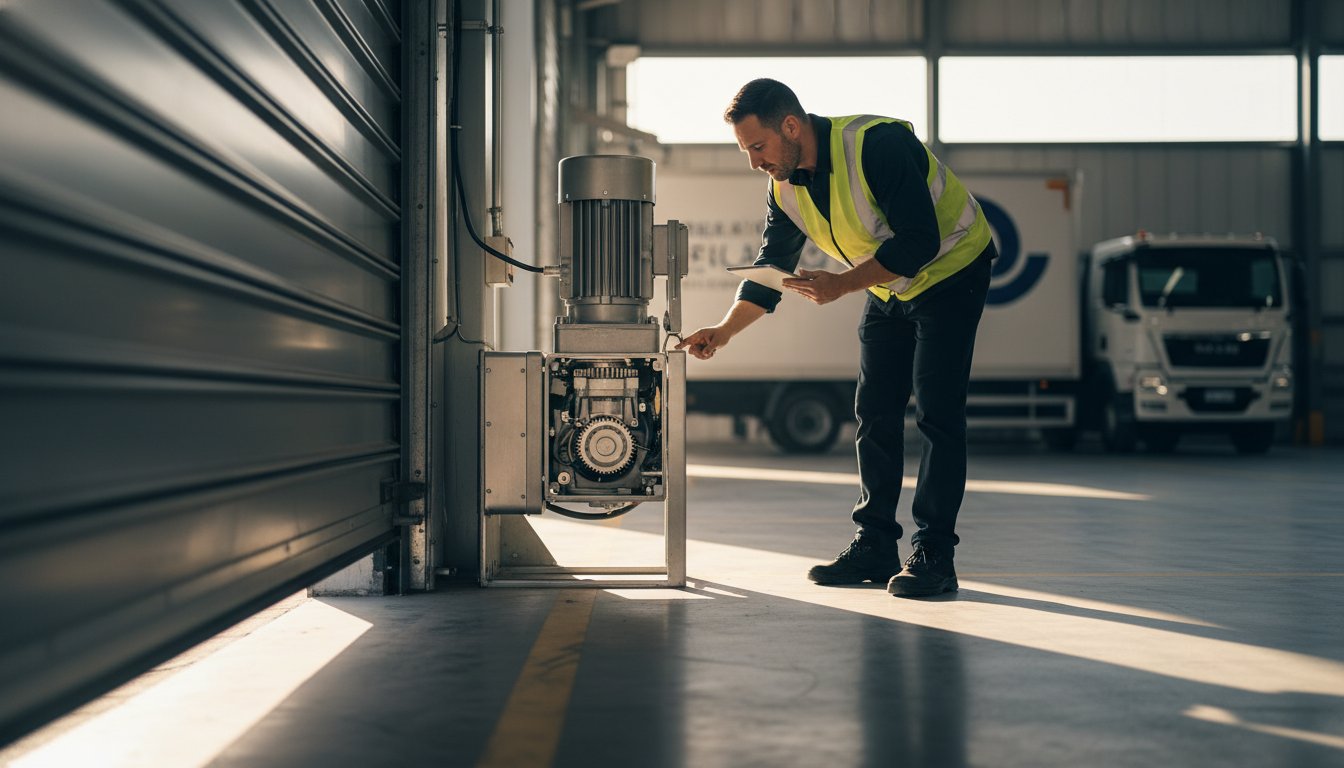
Choosing the wrong motor for your business door is a costly mistake. A residential opener will quickly fail under the demands of daily commercial use, and an underpowered unit puts your operations, security, and safety at risk. Understanding the critical difference between a standard opener and the heavy-duty commercial door motors required for Australian businesses is the first step. The technical details-from duty cycle ratings to 3-phase power requirements-are not just jargon; they are essential for selecting a reliable, compliant, and correctly specified motor for your high-use roller, shutter, or sectional door.
This guide provides the direct, practical information you need to make an informed decision. We cut through the confusion to explain the key technical specs, must-have features for high-traffic environments, and the differences between motor types. By the end, you will be able to confidently identify the correct motor for your specific application, ensuring you invest in a solution built for lasting performance and reliability. Get the right information to make the right purchase.
Residential vs. Commercial Door Motors: What's the Real Difference?
Attempting to use a residential garage door motor for a business is a common but costly mistake. It’s like trying to haul a tonne of bricks with a passenger car instead of a ute-it simply isn't designed for the job and will fail quickly. The core differences between residential and commercial door motors come down to three critical factors: durability, power, and safety compliance. Choosing the wrong type leads to frequent breakdowns, expensive downtime, and significant safety risks for your staff and customers.
To see how modern commercial operators are designed for these demands, watch this overview:
Duty Cycle and Durability
A motor's duty cycle is the number of times it can open and close a door per day without overheating or wearing out. A residential motor is built for 4-6 cycles per day. In contrast, commercial door motors are engineered for high-frequency use-from 25 to over 100 cycles daily in busy environments like car parks or loading docks. They achieve this with heavier-duty components, including industrial-grade gearboxes, stronger chains, and more robust internal mechanics designed for constant operation.
Power and Lifting Capacity (Torque)
Commercial doors are significantly larger, heavier, and often subject to wind load, requiring far more power (torque) to operate safely. A motor must be precisely matched to the door's weight and size. Using an underpowered residential motor on a heavy commercial door puts immense strain on the unit, leading to rapid burnout and failure. While counterbalance springs do much of the heavy lifting, the motor provides the consistent force needed for thousands of cycles.
Safety and Compliance Standards
Commercial and industrial sites in Australia must adhere to strict Workplace Health and Safety (WHS) regulations. Motors installed in these environments require specific safety features not always standard on residential models. Key requirements include:
- Photo-Electric Safety Beams: An infrared beam across the doorway that, when broken, immediately stops or reverses the door to prevent impact.
- Auto-Reverse Functionality: Senses an obstruction and automatically reverses the door's direction.
- Emergency Manual Override: A reliable chain or crank system to operate the door manually during a power failure or emergency.
How to Choose the Right Commercial Door Motor: 5 Key Factors
Selecting the correct motor is the most critical step in automating a commercial door. An underspecified motor will fail prematurely, while an over-specified one is a waste of money. Before you purchase, work through this pre-purchase evaluation. Answering these five questions ensures you select the right commercial door motor for your specific operational needs, guaranteeing performance and longevity.
1. What are your door's specifications?
The physical properties of your door determine the power required. You must know:
- Size: Measure the door's height and width to calculate its total area in square metres (m²). Motors are rated for a maximum door size, for example, up to 28m².
- Weight & Material: Is the door made from light aluminium, Colorbond or heavy steel slats? Heavier doors require motors with more torque.
- Type: The style of door dictates the type of motor. A large roller door often needs a heavy-duty direct drive motor, while a sectional door uses a different drive mechanism.
2. How often will the door be used?
This is your "duty cycle" and it's a critical factor. Estimate the number of open-and-close cycles your door will perform each day. A small storage unit might be light use (under 20 cycles/day), whereas a busy underground car park is heavy use (100+ cycles/day). High-cycle commercial door motors are engineered for this demand, often including features like integrated cooling fans to prevent overheating and ensure reliability.
3. What power supply is available on site?
This is a non-negotiable technical requirement. Check what power is available at the door opening.
- Single-Phase (240V): Standard power for most smaller commercial applications.
- Three-Phase (415V): Required for larger, heavier doors and high-frequency use. It provides more consistent power and greater torque.
If you are unsure, consult a licensed electrician to confirm the available power supply before ordering your motor.
4. What is the operating environment?
Consider where the motor will be installed. Is it a dusty warehouse, a wash-down bay with high moisture, or a coastal building exposed to corrosive salt air? The motor's IP (Ingress Protection) rating indicates its resistance to dust and water. A higher IP rating means better sealing, protecting the internal electronics from damage and ensuring a longer service life in harsh conditions.
5. What control and safety features are required?
Finally, determine how you need to operate the door. Do you need simple wall-mounted push buttons, or multiple remote controls for staff vehicles? For safety and compliance, especially in public-access areas, photo-electric (PE) safety beams are essential to prevent the door from closing on a person or object. Consider if you need advanced logic for features like auto-close timers or integration with building access control systems.
Types of Commercial Motors by Door Application
The most effective motor for your business depends entirely on the type of door it needs to operate. Matching the motor to the door's size, weight, and daily usage cycle is critical for performance and longevity. This section breaks down the most common commercial door motors by their intended application, helping you identify the right solution for your site.
Motors for Commercial Roller Doors & Shutters
Large, heavy-duty rolling steel doors found in industrial settings require motors with significant torque to manage the curtain's weight. The two primary mechanisms are direct drive and hoist operators.
Direct Drive Motors mount directly onto the door's axle. This simple, robust design provides efficient power transfer with fewer moving parts, making it a highly reliable choice for frequent use. Hoist (Chain-Driven) Motors use a gearbox and chain system to drive the door's main sprocket. They are ideal for exceptionally large and heavy shutters and typically include a manual hand chain for emergency operation during a power failure.
These motors are the standard for warehouses, loading docks, industrial sheds, and self-storage facilities. Door Supply stocks a range of powerful and reliable options.
Motors for Commercial Sectional Doors
Commercial sectional doors often use high-lift or vertical-lift tracks to maximise overhead clearance. This makes standard residential-style trolley openers unsuitable. Instead, the industry standard is the jackshaft opener.
A Jackshaft Opener mounts on the wall beside the door opening and connects directly to the torsion bar. By turning the bar itself, it lifts the door smoothly and efficiently. This side-mount configuration keeps the ceiling area completely clear, which is essential for car service centres with vehicle hoists, fire stations needing maximum clearance for trucks, and high-ceiling commercial showrooms.
Logic Controls and Smart Features
Modern commercial door motors are controlled by sophisticated logic boards that offer far more than simple open-and-close functionality. These advanced controllers allow you to customise door operation to improve site efficiency, security, and maintenance.
Key features that deliver practical benefits include:
- Timer-to-Close: Automatically closes the door after a preset time, improving security and climate control without manual intervention.
- Service Indicators: The controller can track usage cycles and signal when preventative maintenance is due, helping to avoid costly breakdowns.
- Fault Diagnosis: Onboard diagnostics display error codes to help technicians quickly identify and resolve issues, minimising operational downtime.
- Accessory Integration: Seamlessly connect essential accessories like safety beams, ground loop detectors, and keypad access systems.
Essential Features and Accessories for Business Operations
A high-performance motor is the core of your automated door system, but it's the accessories that tailor it to your specific business needs. Selecting the right features enhances security, ensures safety compliance, and improves daily operational efficiency. These are not optional extras; they are vital components that integrate with commercial door motors to create a complete and reliable access solution.
Access Control Systems
Control who enters your premises and when with a range of access options designed for commercial use. We supply systems for every application, from simple push-button operation to fully integrated security.
- Heavy-Duty Remotes: Robust, multi-channel remote controls for vehicle or key staff use.
- Wall-Mounted Push Buttons: Simple and reliable internal buttons for frequent open/close cycles in warehouses or workshops.
- Digital Keypads: Provides code-based entry for authorised personnel, eliminating the need to issue multiple keys or remotes.
- Induction Loops: In-ground vehicle detectors automatically trigger the door upon approach, ideal for high-traffic car parks and loading docks.
- Swipe Card or RFID Integration: Options to connect the door motor with existing building security systems for seamless access control.
Mandatory Safety Mechanisms
In a commercial environment, safety is non-negotiable. Our automation systems are designed to integrate essential safety devices to protect people, vehicles, and property. These features are often required to meet Australian safety standards.
- Photo-Electric (PE) Safety Beams: An infrared beam is projected across the door opening. If the beam is broken by an obstruction, the door will immediately stop or reverse, preventing impact and injury.
- Auto-Reverse Functionality: The motor’s internal logic detects physical obstructions during operation and automatically reverses the door's direction to prevent damage.
Manual Overrides and Battery Backup
A power outage should not halt your operations or compromise your site's security. We offer solutions to ensure your door remains functional at all times.
- Manual Chain Hoist: A standard feature on most heavy-duty commercial door motors, allowing you to manually open or close large doors by pulling a reduction-geared chain.
- Declutch Mechanism: A quick-release system to disengage the motor from the door, allowing for immediate and easy manual operation.
- Battery Backup (BBU): An integrated or external power unit that provides temporary power during an outage, ensuring seamless, uninterrupted automated operation. A BBU is critical for sites like secure car parks, emergency services, and high-traffic warehouses.
Explore our full range of compatible accessories to build your complete access solution at doorsupply.com.au.
Find the Right Commercial Door Motor for Your Operations
Selecting the correct motor for your commercial door is a critical investment in your business's security, efficiency, and safety. The key is to understand the significant differences from residential units, carefully evaluate factors like door weight and usage frequency, and match the motor type to your specific door application. This ensures you get a solution built for demanding, high-cycle environments.
Investing in high-quality commercial door motors is a straightforward decision that pays off in reliability and operational uptime. At Door Supply, we provide a comprehensive selection of heavy-duty units, including proudly Australian-made options. With nationwide delivery direct to your business or site, getting the right equipment is simple. View our range of commercial and industrial door motors today and equip your business with the power and reliability it deserves.
Frequently Asked Questions
How much power does a commercial door motor need?
The required power depends directly on the door's size, weight, and usage frequency. A small shopfront roller door may only need a 0.5 horsepower (HP) motor. In contrast, a large, heavy industrial door, especially one that is wind-rated or insulated, will typically require a 1.0 HP to 1.5 HP motor to operate safely and reliably. Always consult the door’s specifications to ensure you select a motor with the correct power rating for the load.
What is the difference between single-phase and three-phase motors?
Single-phase motors operate on standard 240V power, which is common in small businesses and residential settings. They are ideal for light to medium-duty commercial applications. Three-phase motors require a 415V power supply, typically found in industrial or large commercial sites. They provide more consistent, efficient power, making them necessary for very large, heavy, or high-cycle doors where performance and durability are critical.
Can I install a commercial door motor myself?
We strongly recommend professional installation. Commercial doors operate under extreme tension and are very heavy. Installation involves complex electrical wiring, especially for three-phase systems, and requires specialised tools and knowledge to ensure safety and compliance with Australian standards. Incorrect installation poses a significant safety risk, can damage the door or motor, and will void the product warranty. Door Supply is a supply-only service.
How long do commercial garage door motors last?
A high-quality, professionally installed commercial door motor can last 10-15 years, or even longer with proper care. The main factors influencing its lifespan are the quality of the unit and its duty cycle (the number of times it operates per day). A motor on a high-traffic warehouse door will wear out faster than one on a small, infrequently used storage unit. Regular maintenance is key to maximising its operational life.
What are the leading commercial door motor brands in Australia?
In the Australian market, Grifco (by Chamberlain) and Automatic Technology (ATA) are widely recognised as leading brands for commercial door automation. Both manufacturers are known for producing robust, reliable, and powerful motors designed specifically for Australian conditions. They offer a wide range of products suitable for everything from light commercial roller doors to heavy-duty industrial shutters and gates, ensuring a solution for nearly any application.
Do commercial motors require regular maintenance?
Yes, regular professional maintenance is crucial for all commercial door motors. Given their heavy loads and high usage, routine servicing ensures safe operation, prevents unexpected failures, and extends the motor's lifespan. A technician should inspect and lubricate moving parts, check chain tension, test safety features, and verify electrical connections annually. For high-cycle applications, servicing may be required more frequently.
This same principle of professional servicing applies to other essential site equipment. For instance, businesses with loading docks often rely on industrial scales for logistics and compliance, where regular calibration and support from a specialist is vital for operational accuracy.